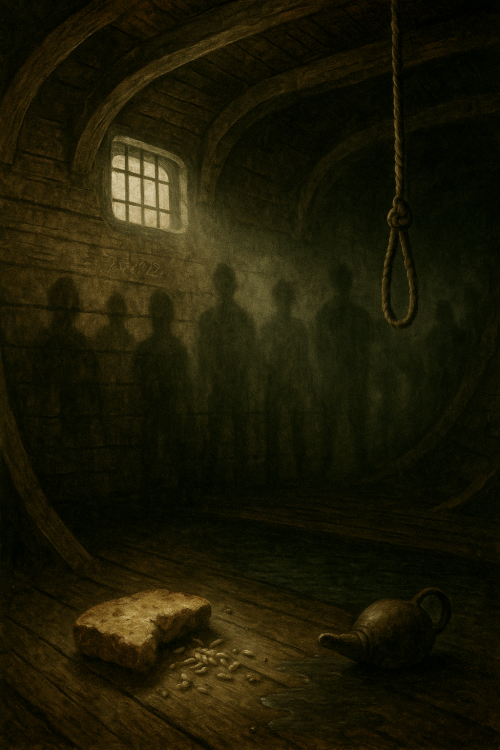
The portholes of the vessel had all been sealed and breathing holes covered in iron bars ran the length of the ship. It was freezing in winter and like an airless oven in summer. Frostbite and suffocation claimed the lives of the prisoners depending upon the season.
Captain Coffin remarked that: ‘I can safely aver, that both the times I was confined on board the prison ships, there never were provisions served out to the prisoners that would have been eatable to men that were not literally in a starving situation.’
This was hardly a question of winning the hearts and minds of His Britannic Majesty’s American subjects. The enemy were seen as rebels, as less than men, and accordingly the captors did not give a damn for their lives or care about the intolerable and vengeful way that they were being treated.
The bread was mouldy, and filled with worms
Ebenezer Fox remembered how: ‘The bread was mouldy, and filled with worms. It required considerable rapping upon the deck before the worms could be dislodged from their lurking places in a biscuit’.
An edition of the Connecticut Gazette from July 1778 relates the story of Robert Sheffield, one of the few survivors. He speaks of his time upon the Jersey: ‘The heat was so intense that (the 300-plus prisoners) were all naked, which also served the well to get rid of vermin, but the sick were eaten up alive. Their sickly countenances, and ghastly looks were truly horrible; some swearing and blaspheming; others crying, praying and wringing their hands; and stalking about like ghosts; others delirious, raving and storming, all panting for breath; some dead, and corrupting. The air was so foul that at times a lamp could not be kept burning, by reason of which the bodies were not missed until they had been dead ten days. One person alone was admitted on deck at a time, after sunset, which occasioned much filth to run into the hold, and mingle with the bilge water…’
In his book Rebel Cities, Mike Rapport gives more gruesome details: ‘Conditions were appalling. According to General Gage, one-time British commander in North America, rebels were criminals, ‘destined to the cord’, not prisoners of war, so were lucky to be alive at all. Moreover, the challenges of feeding British troops meant that American prisoners received reduced rations: they would have lost one pound of their body weight a week, a gradual wasting away that took a terrible toll… Worst of all, with the city’s gaols crammed with so much festering humanity, the British resorted to a solution that they had already tried on criminals back home: prison hulks… Conditions were so squalid aboard these vessels that the filth-smeared inmates were woken each morning by the gaolers’ calls of ‘Rebels, turn out your dead’. In all, it has been estimated that between 24,850 and 32,000 Americans were held prisoner in and around Manhattan, and of these somewhere between 15,575 and 18,000 died – maybe 11,000 in the prison hulks. This shocking figure dwarfs the American combat dead of 6,824 and even the 10,000 thought to have died from wounds or disease.’
Callous rejection of common humanity
Such a cold and heartless policy was bound to antagonize the rebels and make them hate the British even more. As a result the Americans would fight all that much harder to avoid capture and almost certain death on the hulks.
From the very start George III, his politicians and generals, had absolutely no understanding of or sympathy for their opponents who simply wanted some say in the policies that affected them very deeply and could lead both to their penury and abject misery.
We have seen how William Hazlitt’s father protested about the treatment of American prisoners in Ireland so this callous rejection of common humanity was obviously endemic within the British ruling class and their ever-expanding Empire. (Wellington for one couldn’t give a damn for the ordinary soldier on his own side – leave alone that of his enemy).
The later appalling treatment of Napoleon upon the island prison of Saint Helena only emphasizes that fact.
James E. Held in an article entitled: British Prison Ship, a Season in Hell, puts these terrible events into stark perspective. He states that: ‘To the Crown, rebellious Americans were no better than the restless Irish and Scots – traitors to the realm, not prisoners of war.’
As he makes clear, there was no such thing as the Geneva Convention in those days. Many American troops did not were a uniform and used unorthodox tactics that bewildered their enemy: ‘New World warfare against frontier warriors and Massachusetts Minutemen, who reputedly scalped British dead on the Concord Bridge and specifically targeted officers, exhibited a savagery and sordidness that most English troops never before encountered. The trauma of this war scarred the psyche of British fighting men, also affecting their treatment of prisoners.’
Washington himself was also often reluctant to exchange prisoners as most of his men were amateurs and not professional soldiers. On the other side, many Loyalists hated their opponents with a visceral intensity.
William Cunningham who became Provost Marshal of New York was an Irish immigrant. He had been personally attacked and abused by 200 Sons of Liberty in early 1775 and this completely warped his sense of honour and corrupted his morals. Woe betide any rebels that fell into his bloodthirsty grip: ‘Cunningham stole and sold the rations of 2,000 prisoners, and historian Henry Onderdonk documented his secretly hanging or poisoning hundreds of captives.’
The Long Island Genealogy website also condemns his heinous policies: ‘The most outrageous of all the crimes committed by Cunningham was the hanging of 275 American prisoners of war without trial and in utter repudiation of all existing articles of war. The ignominious and undercover hanging of war prisoners was a blot on the British military government.’
It goes further asserting that: ‘There was obviously a conspiracy among Provost Marshal William Cunningham, Commissary Joshua Loring, and Naval Commissary David Sprout, down to the lowly prison guards, to decimate the rebels… This extermination policy now appears to have been a deliberate conspiracy not only among the prison commissaries, but actually by the British High Command.’
Napoleonic Wars, a misnomer
While all this abuse was going on during the American War of Independence, Napoleon, who was born in 1769, was just a boy. The French had suffered a humiliating defeat at the hands of the British during the Seven Years’ War of 1756-1763, long before he was even born.
This was one of the reasons that the French had supported the Americans a decade or so later – they wanted to get their own back. Even though the earlier fighting on a global scale from 1756-1763 had virtually bankrupted the French nation, their navy and temporary command of American waters was used at critical moments during the American Revolution to help the colonists gain eventual victory over their erstwhile masters.
The French and the British were traditional enemies yet the conflict that came later after the French Revolution is always dubbed The Napoleonic Wars. A misnomer if ever there was one. The origin of that word comes from the Old French mesnommer – very apposite.