A button and two passenger jets. What have they to do with Napoleonic history? We shall now see…
On ‘Nine Eleven’ 2001, two planes seized by Islamic terrorists from Al-Qaeda crashed into the twin towers of the World Trade Center. It was one of the greatest atrocities of modern times and many people can recall where they were and what they were doing when they heard the terrible news. The shocking images repeated over and over again on TV screens around the world were seared into the brains of the horrified viewers – images never to be forgotten.
The author was doing voluntary work deep in the basement archives of the Mappin Museum and Art Gallery in Sheffield, Yorkshire, England. He can still recall the stunned looks on the faces of colleagues as they talked about the tragedy the very next day.
An old ship came to light
Very few people know that the twin towers were built literally over a site linked to an even greater atrocity. In 2010 when the construction of a new high security park and garage was underway it was decided to make the entrance underground and this necessitated digging foundations much deeper than those of the earlier iconic towers. It was while this process was going on that some twenty two feet beneath the tarmac, the wreck of a very old ship came to light. Building stopped immediately and an archeological team headed by Warren Riess, the principal investigator, set to work.
The site was scanned with lasers and hi-res 3D data was transferred to the latest computers. Ground Zero had an entirely new story to tell. The flattened but well-preserved vessel was in the heart of Manhattan, five hundred yards from the current shoreline. As Riess said, the fifty foot long boat was ‘not only rare, it was one of a kind’.1 When the ships timbers were uncovered the tree rings showed that they had been felled in 1773 or soon after. In other words, it was a vessel dating from the American War of Independence.
It was like a time capsule – a secret time capsule 2 said Riess.
In 1773 New York had a population of 25,000 people and its sheltered harbours were of massive strategic and commercial consequence. When the Revolution against the British Government began in 1775 New York was a prime target for attack from the Royal Navy and the British Army.
How do we know that the vessel belonged to the British? As well as the 327 pieces of ordnance found scattered amongst the ancient timbers, including cannon balls and 56 musket balls, a single button was discovered amidships between two of the planks. On the pewter button was stamped the number 52. That was a regimental number from the British Grenadiers – ‘aggressive assault troops’.3
The most lethal place
A fifty foot long boat with a beam of eighteen feet and a draught of only four feet was obviously not meant for the high seas. So what was it used for?
It was ideal for the shallow coastal waters and the innumerable coves and bays that surrounded Manhattan at that time. It was a transport vessel used to cross two miles of the notorious waters of Wallabout Bay off the shores of Brooklyn to a number of old stationary ships. It was crewed by British grenadiers and its usual cargo was American prisoners of war who were being taken to the notorious and pestiferous hulks rotting in the bay.
Riess adds: ‘it was the most lethal place during the whole Revolution for the Americans’.4
Professor Robert Watson remarks that: ‘New York City still has its secrets, its dark past, including the most grisly and bloodiest event of the entire revolutionary war’.5
In an episode from Drain the Oceans: Secrets of New York City, the narrator says the place was called ‘Hell afloat’ and was: ‘A flotilla of festering British ships, overcrowded, freezing cold, poorly supplied and run by brutal guards’.6 The hulks were hotbeds of disease and infection and some 11,000 men are thought to have died on the infamous HMS Jersey alone. That is more than three times the death toll from Nine Eleven and yet most Americans have probably never heard of it.
It was a forgotten secret that the author only discovered after a lifetime of reading history at the age of sixty-five. To put the death toll in even greater perspective, twice as many Americans died on the Jersey than in the whole of the rest of the conflict. Professor Watson states: ‘It is unimaginable’.7
It is almost never mentioned in English history books.
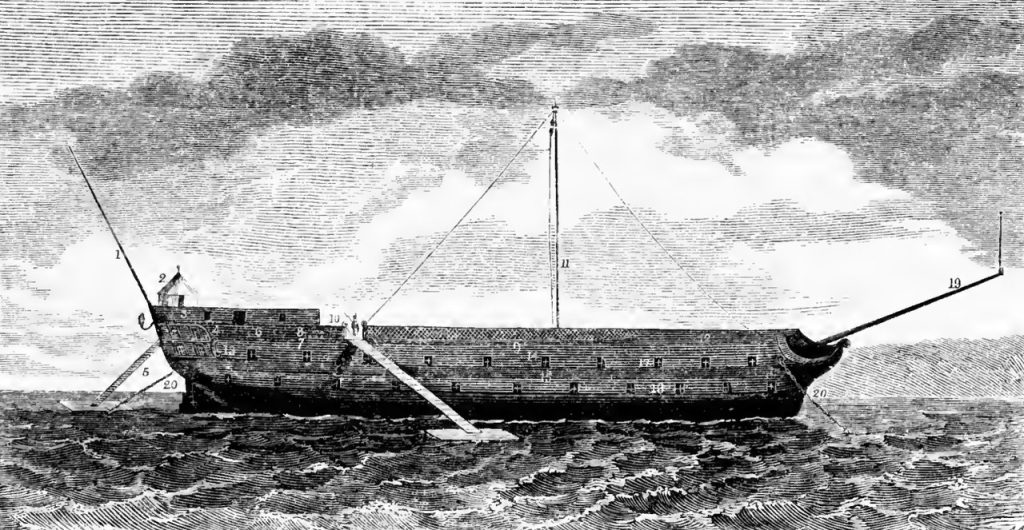
Only 1,400 survivors
On the History website the editors speak of HMS Jersey and: ‘the obscenely high death rate of its prisoners’, and says: ‘One of the most gruesome chapters in the story of America’s struggle for independence from Britain occurred in the waters near New York Harbor, near the current location of the Brooklyn Navy Yard.
From 1775 to 1783, the British forces occupying New York City used abandoned or decommissioned warships anchored just offshore to hold those soldiers, sailors and private citizens they had captured in battle or arrested on land or at sea ( many for refusing to swear an oath of allegiance to the British Crown).’8
Refusing to swear allegiance could thus amount to a death sentence and a very slow and agonising death at that.
The website adds that: ‘More than 1,000 men were kept aboard the Jersey at any one time, and about a dozen died every night from diseases such as small pox, dysentery, typhoid and yellow fever, as well as from the effects of starvation and torture… At war’s end there were only 1,400 survivors among the inmates of the entire prison ship fleet…’9
One wonders what might have been said about the British Government afterwards had there been the equivalent of the Nuremberg Trials. It was a gross and wretched abuse of power.
Many of the survivors later wrote about their experiences in letters and memoirs. Ebenezer Fox was only seventeen when he was incarcerated in 1781. He states that the prisoners were: ‘a motley crew, covered with rags and filth; visages pallid with disease, emaciated with hunger and anxiety, and retaining hardly a trace of their original appearance.’10
Captain Alexander Coffin whose name must have tempted fate, suffered two stints aboard the Jersey. He recalled that the inmates existed in: ‘the most deplorable situation, mere walking skeletons, without money, and scarcely clothes to cover their nakedness, and overrun with lice from head to feet’.11

à suivre le second épisode…